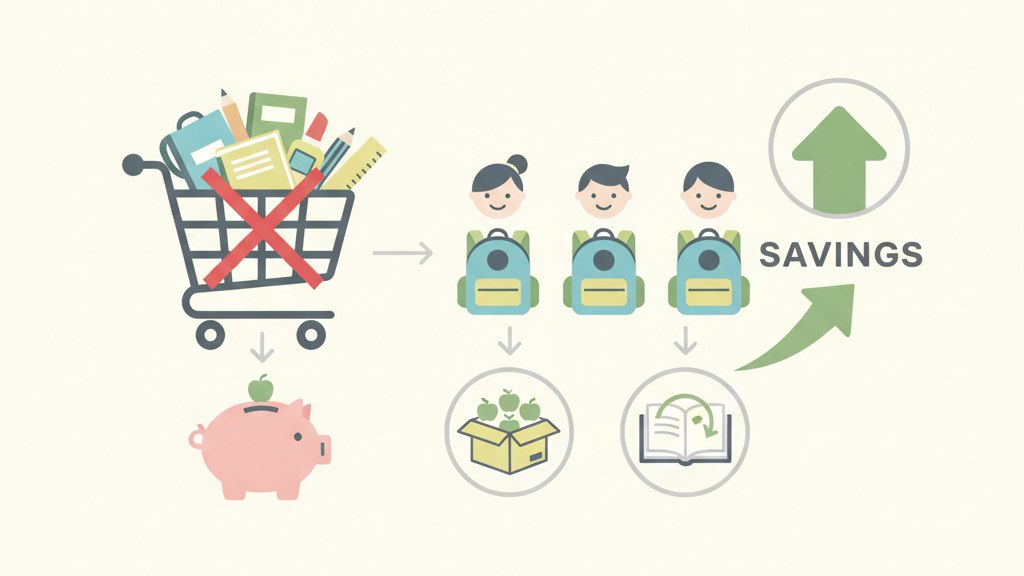
When you have two, three, or more kids headed back to the classroom, school supply lists stop being a minor line item and start looking like a major financial hurdle. According to the National Retail Federation, American families routinely spend hundreds of dollars per child on back-to-school items each summer. Knowing how to save money on back to school supplies for multiple kids isn’t just about cutting coupons—it requires a coordinated strategy to avoid duplicate buying, outsmart retailer pricing tricks, and stretch every dollar across grade levels.
Who this is for: Parents and caregivers managing back-to-school shopping for two or more children who want to dramatically lower total out-of-pocket spending without sacrificing what their kids actually need for the classroom.
TL;DR: Audit what you already own before buying anything, pool shared supplies in bulk across grade levels, leverage state tax-free holidays, enforce strict boundaries on branded gear, and use a staged buying schedule rather than purchasing every item in a single trip.
The Multi-Kid Multiplier: Why School Supply Budgets Explode
Shopping for one student is fairly straightforward: you take a single list, hit a big-box store, and check off the boxes. But when you multiply that process by three children across elementary, middle, and high school, small costs compound rapidly. A dozen glue sticks, four packs of loose-leaf paper, three sets of colored pencils, and specialized calculators can easily push total family spending past $800 when combined with backpacks and shoes.
Retailers count on parent fatigue. When you are balancing three separate supply lists in the middle of a crowded store aisle, it is easy to give up and throw name-brand items into the cart just to finish the trip. That convenience tax adds up quickly. A single name-brand 3-ring binder might cost $8, while an identical store-brand alternative sells for $2.50. Across 12 binders for three kids, that single brand preference costs you over $65 in extra spending.
The secret to keeping your sanity and your savings intact is treating back-to-school prep like supply chain management. By standardizing what you buy, buying high-volume staples in bulk, and staggering your purchases, you eliminate the single-trip blowout that wrecks summer budgets.
Phase 1: The Great Home Supply Audit (Stop Buying Duplicates)
The single biggest mistake parents make when shopping for multiple kids is buying brand-new items before inventorying what is already scattered around the house. Children rarely finish an entire pack of colored pencils, use every page of every notebook, or destroy every plastic folder during a single school year.
Before you view a single store ad or visit a retail website, gather every backpack, desk organizer, pencil case, and storage bin in your home. Dump all existing school supplies onto a single large table—the dining room table works best—and categorize everything into distinct piles:
- Writing tools: No. 2 pencils, mechanical pencils, blue/black pens, highlighters, and colored pencils. Test pens and markers on a piece of scratch paper and discard dead ones immediately.
- Paper products: Unused spiral notebooks, partially used notebooks (rip out used pages to reset them), composition books, and loose-leaf filler paper.
- Hard goods: Binders, plastic prong folders, rulers, child-safe scissors, compasses, protractors, and scientific calculators.
- Containers: Backpacks, lunchboxes, pencil pouches, and bento boxes. Check zippers, seams, and insulation. Wash dirty backpacks in the gentle cycle and air dry them.
Once everything is sorted, compare your home inventory against each child’s official school list. Cross off every item you already have in functional condition. If your fifth grader has four usable plastic folders from last year, cross those off. If your middle schooler has an intact scientific calculator handed down from an older sibling, cross that off too. Most families discover they can satisfy 25% to 40% of their total supply list directly from existing household inventory.
Strategic Bulk Buying vs. Individual Customization
When you have multiple children, purchasing items individually at retail price is a guaranteed way to overspend. However, bulk buying only saves money if you buy the right items in bulk and know where customization actually matters to your kids.
What to Buy in Bulk (Shared Pool Items)
Certain items are standard across almost all grade levels. These items should be bought in bulk packages from wholesale clubs (like Costco or Sam’s Club) or online commercial distributors, then pooled at home in a central supply station:
- No. 2 Wood Pencils: Buying a pack of 96 or 144 pre-sharpened pencils costs a fraction per unit compared to buying small 10-packs.
- Glue Sticks & Erasers: Teachers often request 6 to 10 glue sticks per elementary student. Buy multi-packs of 24 or 30.
- Unruled & Wide-Ruled Loose Leaf Paper: High schoolers and middle schoolers churn through paper rapidly. A bulk pack of 1,000 sheets serves multiple kids for the whole year.
- Tissues, Disinfectant Wipes, & Hand Sanitizer: Almost every classroom list requests these communal contributions. Buying multi-packs at wholesale clubs cuts per-unit costs in half.
- Dry Erase Markers: Black chisel-tip Expo markers are universal items from 1st through 12th grade. Buy a 12-pack or 24-pack for the entire household.
Where to Allow Individual Customization
If you force complete uniformity on your children, you risk pushback and impulse demands inside the store. Reserve personal customization for 1 to 2 visual items per child:
- Backpacks & Lunchboxes: Let kids choose their preferred pattern or color, provided it meets durability standards.
- Pencil Pouches & Covers: A inexpensive customized pencil case or folder design gives kids a sense of personal style without breaking the bank.
- Primary Notebook Design: Allow each child to pick one or two decorative notebooks for their primary classes, while using plain solid-color notebooks for secondary subjects.
By establishing clear boundaries—bulk purchases for functional baseline items, individual choice for gear—you eliminate arguments before setting foot in a store.
Timing the Market: Sales Cycles, Tax Holidays, and Clearance Shifts
School supply pricing is highly volatile between July and October. Retailers use loss leaders—items sold below cost, like 15-cent spiral notebooks or 50-cent crayon boxes—to lure you into the store where you’ll buy high-margin items like $30 backpacks or $15 water bottles. Understanding how to navigate these retail pricing waves is essential to maximizing your savings.
| Shopping Window | Best Items to Purchase | Typical Discount Level | Strategy / Tip |
|---|---|---|---|
| Early July | Backpacks, lunch gear, tech gear | 10% – 20% off | Best selection for long-lasting durable items before stock thins out. |
| Late July – Early August | Standard paper, pencils, glue, crayons | 50% – 80% off (Loss Leaders) | Hit weekly store doorbusters for deep discounts on basic paper goods. |
| State Tax-Free Weekend | Clothing, footwear, major tech ($100+) | Varies by state tax rate (4%–10%) | Combine state tax exemption with store coupons for maximum stackable savings. |
| Mid-September (Post-Start) | Restock items, extra paper, backup folders | 70% – 90% off clearance | Buy next year’s basic supplies on clearance for pennies on the dollar. |
Leveraging State Tax-Free Holidays
More than a dozen US states offer annual sales tax holidays in late July or early August, specifically targeting back-to-school items. Eligible categories usually include clothing, footwear, traditional art/school supplies, and sometimes computers under a specific dollar cap (e.g., $1,000 per computer or $100 per clothing item).
To maximize a tax-free weekend with multiple kids, make an exact itemized list ahead of time. Combine state sales tax exemptions with manufacturer coupons and retailer loyalty rewards. Be aware that stores often raise base prices slightly right before tax-free weekends on non-promotional items; stick strictly to sale-priced staples to preserve your net discount.
Managing Hand-Me-Downs Without Outrage
In multi-child households, passing down durable goods like backpacks, sports gear, musical instruments, and high-end scientific calculators is crucial for controlling costs. However, younger siblings often resist receiving used items if they feel they are getting second-rate gear while older siblings got new items.
To make hand-me-downs work smoothly without friction, implement these operational rules:
The Refresh Protocol
Never pass an item down in visible disrepair or dirty condition. Before handing down a backpack, lunchbox, or jacket:
- Deep-clean the item thoroughly. Wash fabric items in the washing machine or hand-scrub zippers and seams.
- Replace worn pull-tabs on zippers with fresh paracord or new carabiners.
- Allow the younger child to customize the item with 2–3 low-cost iron-on patches, enamel pins, or keychains. A $15 backpack refreshed with $3 worth of custom patches feels brand-new to an elementary student.
The Calculator Lease Program
Graphing calculators like the Texas Instruments TI-84 Plus can cost upwards of $100 to $130 new. If you have multiple children entering middle or high school, purchasing multiple graphing calculators is an unnecessary drain on your budget.
Establish a family equipment library. High-end calculators, geometry sets, and specialized art gear belong to the household, not individual children. When an older child finishes AP Calculus or Chemistry, the device returns to the family supply closet to be checked out by the next child entering advanced math. If your school allows smartphones or tablets during homework, consider free or cheap software alternatives like Desmos before buying hardware.
Avoiding the Credit Card Traps and Retail Marketing Tricks
When purchasing school supplies for multiple kids, total register totals can easily reach several hundred dollars. This makes impulse buys and payment methods critical leverage points for your budget.
Retailers intentionally stack enticing displays of licensed character gear (Disney, Marvel, video game franchises) at eye level in central aisles. These items carry gross margins up to 300% higher than plain equivalents. A standard 2-pocket folder costs roughly 50 cents; the exact same paper folder featuring a movie character routinely sells for $2.50 to $4.00. Across 18 folders for three kids, buying branded character items costs an extra $36 to $63 for zero additional utility.
Additionally, watch out for payment traps. Retailers frequently offer instant 15% discounts if you open a store credit card at checkout. While the immediate savings look appealing on a $400 purchase, store credit cards often carry APRs exceeding 28% to 30%. If you do not pay off the balance in full immediately, interest charges will rapidly wipe out your initial discount.
Leave a Reply