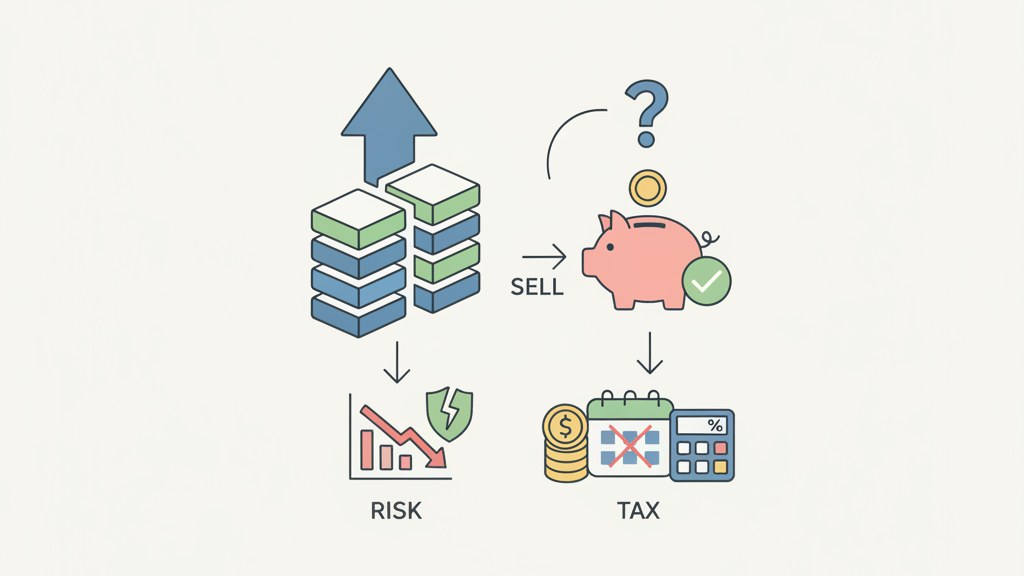
Should you sell your RSUs (Restricted Stock Units) the exact day they vest? For the vast majority of employees, the answer is a resounding yes: selling your shares immediately upon vesting is usually the safest, most efficient financial move you can make. Yet thousands of tech workers and corporate employees hold onto their vested stock every year, operating under the mistaken belief that selling right away triggers massive extra taxes or signals a lack of loyalty to their company.
Who this is for: Corporate and tech employees receiving RSU compensation who want a clear, tax-smart strategy to manage their stock vests without taking on unnecessary investment risk.
TL;DR: RSUs are taxed as cash income the moment they vest, regardless of whether you keep the shares or sell them. Holding vested company stock exposes you to severe single-stock concentration risk. For most people, selling at vest and redirecting the cash into diversified funds or financial goals is the ideal move.
The “Cash Bonus” Rule: Why Selling RSUs Immediately Makes Sense
To understand why selling RSUs immediately is usually the right strategy, you have to reframe how you view equity compensation. The easiest way to break through the mental fog around stock grants is to ask yourself one simple question on vest day:
If your employer gave you a $10,000 cash bonus today (after taxes), would you take every penny of that cash and buy shares of your company’s stock?
If your answer is no—if you would instead use that money to pay off credit card debt, save for a home down payment, max out a Roth IRA, or buy broad-market index funds—then you should sell your RSUs immediately. Keeping the vested stock is functionally identical to taking your cash paycheck and buying individual company shares on the open market.
The Double-Exposure Concentration Trap
Holding significant amounts of your employer’s stock exposes you to dual risk. Your primary source of income (your salary and healthcare benefits) already depends on the financial health of one company. If that company hits a rough patch, experiences layoffs, or sees its stock price plummet, your income and your investment portfolio take a hit at the exact same time.
Financial advisors generally recommend keeping any single stock to no more than 5% to 10% of your total net worth. When you hoard vested RSUs over several quarters or years, your company stock can quickly grow to dominate 30%, 50%, or even 80% of your liquid wealth. That isn’t wealth building; it’s a high-stakes gamble on one company’s quarterly performance.
How RSU Taxes Actually Work (Dispelling the Myths)
The single biggest reason people hesitate to sell RSUs on vest day is confusion over taxes. A common myth is that selling immediately triggers heavy capital gains taxes, while holding for a year unlocks tax savings. That is fundamentally incorrect.
1. Taxation at Vesting (Ordinary Income)
The moment RSUs vest, the IRS treats the full fair market value (FMV) of the vested shares as standard W-2 wage income. It makes zero difference whether you keep the stock or sell it five seconds later. You owe federal income tax, state income tax, Social Security (up to the annual cap), and Medicare tax on that total value.
For example, if 100 shares vest at a market price of $100 per share, your gross taxable income increases by $10,000. Your cost basis in those 100 shares is now established at $100 per share.
2. Taxation After Vesting (Capital Gains)
Capital gains or losses only apply to changes in the stock price after the vest date:
- Immediate Sale: If you sell your 100 shares on vest day at $100 per share, your proceeds equal your cost basis ($10,000). Your net capital gain is $0, meaning you pay zero capital gains tax on the transaction.
- Selling Later at a Profit: If you hold the shares for six months and sell at $120 per share, you will owe short-term capital gains tax (taxed at your normal income tax rate) on the $20-per-share gain ($2,000 total). If you hold for more than a year before selling at $120, that $2,000 gain is taxed at lower long-term capital gains rates (0%, 15%, or 20% depending on income).
- Selling Later at a Loss: If the stock drops to $70 per share and you sell, you realize a capital loss of $30 per share ($3,000 total). You can use this loss to offset other capital gains or deduct up to $3,000 per year against ordinary income on your tax return.
3. The 22% Withholding Shock
When RSUs vest, most employer brokerage platforms (such as Fidelity, Schwab, or E*TRADE) automatically execute a “sell-to-cover” transaction to satisfy tax obligations. By default, the IRS sets the statutory federal withholding rate for supplemental wages under $1 million at 22%.
Here is the catch: if your base salary plus equity pushes your household income into the 24%, 32%, or 35% federal tax brackets, that 22% withholding falls significantly short. Many employees who hold their shares face a surprise tax bill—and potential underpayment penalties—when filing their annual Form 1040 because their company under-withheld on vest day.
Math Worked Example: Holding vs. Selling RSUs
To see how this plays out in real life, consider a scenario where an employee named Sarah receives an RSU vest of 500 shares valued at $100 each ($50,000 gross value).
Assume her combined tax withholding (Federal 22% + State 8% + FICA 7.65%) totals 37.65%. The brokerage automatically sells 188 shares to cover the $18,825 tax bill, leaving Sarah with 312 shares worth $31,175.
| Metric / Outcome | Option A: Sell Immediately | Option B: Hold 1 Year (Stock Rises +20%) | Option C: Hold 1 Year (Stock Drops -30%) |
|---|---|---|---|
| Shares Kept at Vest | 312 shares ($31,175) | 312 shares ($31,175) | 312 shares ($31,175) |
| Action Taken | Sold all 312 shares at $100 | Held 1 year; sold at $120 | Held 1 year; sold at $70 |
| Gross Proceeds | $31,175 cash | $37,440 cash | $21,840 cash |
| Capital Gain / Loss | $0 gain | +$6,265 gain | -$9,335 loss |
| Additional Tax Owed | $0 | ~$940 (15% long-term cap gains) | $0 (Capital loss deduction cap applies) |
| Final Net Value | $31,175 | $36,500 | $21,840 |
Looking at Option B, holding yielded an extra $5,325 after taxes—but it required risking over $31,000 of personal capital on a single stock for 12 months. Option C shows the downside: a stock drop wiped out $9,335 of real money. Selling immediately guarantees you lock in the full cash value earned on vest day without rolling the dice on market volatility.
When Does It Ever Make Sense to Hold RSUs?
While selling immediately is the baseline best practice, there are limited exceptions where holding vested shares might be considered:
- Extremely High Long-Term Conviction: If you have conducted thorough research and believe your company is massively undervalued relative to the market, holding a small portion may fit your risk tolerance. However, limit this to no more than 5% of your total liquid net worth.
- Unfavorable Trading Windows & Lock-Ups: Executive trading blackout periods or lock-up windows can make immediate selling impossible. If your company is going public, understanding trade restrictions is essential; I wrote about how lock-up restrictions work in my guide on
Leave a Reply